
B2B prospecting can no longer be a volume game.
How companies can lower cost per lead without losing opportunities
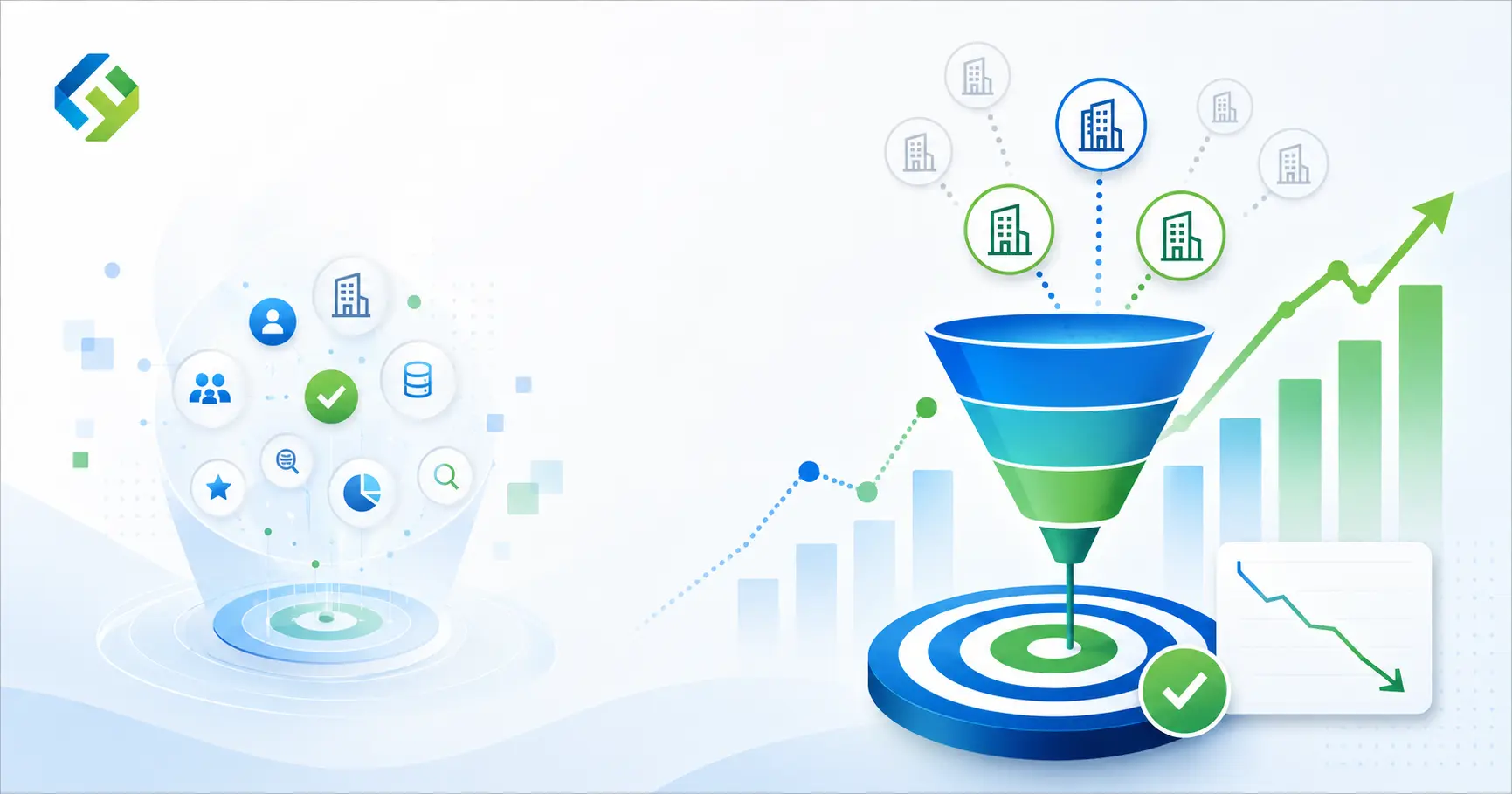
For many companies, prospecting still starts in the same place: the largest possible list of companies, a few broad criteria and the hope that enough opportunities will emerge from volume alone. At first glance, the approach seems logical. If you send more messages, make more calls and run more campaigns, you should get more leads. In practice, however, budgets are spent on unsuitable contacts, and cost per lead rises without making the pipeline healthier.
The problem is not always the communication channel
In B2B sales, time is one of the most expensive resources. Salesforce shows that sales representatives spend 60% of their time on activities that are not actual selling, such as data administration, internal preparation or various operational processes. If an important part of the remaining time is spent on companies that do not fit the profile, do not have a clear need or are not stable enough, the real cost of prospecting can become higher than the campaign budget.
Therefore, the first question should not be how we reach more companies, but how we reach the companies that fit our service or product.
Efficient prospecting starts with profiling
For marketing and sales specialists, the answer starts with profiling. Not all active companies are relevant prospects. Some have the right CAEN code but not the right size. Others are in the targeted county but do not have enough financial capacity. Some look interesting on paper but do not resemble the companies that have already bought. Efficient prospecting does not start from the whole market, but from the profile of a good customer.
This is even more important in a context where B2B buyers prefer to inform themselves. Gartner showed in 2025 that 61% of B2B buyers prefer a purchasing experience without direct interaction with a sales representative. If the prospect no longer enters a conversation quickly, the data, the message and the timing of the approach must be much better.
A second step is validating commercial assumptions. Many campaigns fail not because the message is weak, but because the list of companies is too generic. A company selling services for distribution may be tempted to approach all businesses in a certain sector. But between a regional distributor with solid turnover, a startup-type business with low activity and a company with no clear growth signals, the differences are major. All of them can appear in a raw search.
This is where segmentation discipline appears. A good list does not mean just many rows in an Excel file. It means clear criteria: field of activity, location, size, age, financial indicators, activity signals, product relevance and acceptable risk. For a marketing specialist, these filters increase the chances that the message will reach a company with a real need. For a finance or procurement manager, the same data reduces the risk of unpaid invoices. For an entrepreneur who does not have time to manually check dozens of sources, they bring speed and control.
Data quality also matters because information degrades
ZoomInfo mentions a benchmark of approximately 30% annual decay in B2B contact data, driven by role changes, reorganizations and changes within companies. More broadly, Gartner estimates that poor-quality data costs organizations, on average, at least 12.9 million dollars per year. For SMEs, the absolute sum is obviously different, but the mechanism is the same: wrong data leads to wasted time, slow decisions, more expensive campaigns and risky collaborations.
Lead generation channels do not play the same role
Lead generation channels should also be viewed differently. SEO, editorial content, LinkedIn, email, outbound, events and partnerships do not play the same role. Some build trust. Others test segments. Some bring short-term demand, while others keep the brand in the minds of companies that will buy later. LinkedIn B2B Institute supports the 95-5 rule, according to which only a small part of B2B buyers are active in the market at a given moment, while most may become relevant later.
This means reducing cost per lead is not achieved simply by cutting expensive channels. It is achieved by matching each channel to the right objective. Outbound works well when the list is well documented. Email performs better when segmentation is clear. Educational content helps segments that are not yet ready to buy. Paid campaigns make more sense when the audience is built on realistic criteria, not on broad approximations.
Relevant examples
In this framework, data tools can become useful if they are used with discernment. For example, the Super-Target, available after logging in on ListaFirme.ro, starts from the companies saved in Work List and identifies other companies with a similar profile based on traits such as geographic distribution, field of activity, company size, age, number of employees, turnover, assets and profit. It is especially useful when a company wants to start from clients or prospects that are already validated and find businesses with a similar profile, not just companies extracted through general filters.
What matters is that the initial list is coherent. If clients for different products, unrelated industries or companies with completely distinct needs are mixed together, the result will be harder to use. Good prospecting requires a clear hypothesis: are we looking for firms similar to the most profitable clients, to those who buy quickly, to those who responded to campaigns or to those suited for a specific service?
Conclusion
In the end, lowering cost per lead does not come from doing more, but from wasting less. Fewer irrelevant contacts. Fewer campaigns sent to the wrong companies. Fewer hours lost in manual checks. More attention to data, segmentation and prioritization.