
New Companies, New Clients
Competition for new clients no longer starts when a prospect asks for a quote. It starts much earlier, when that company enters the market and begins looking for its first suppliers.
For sales, marketing, distribution, financial services, software, telecom, logistics, consulting or recruitment teams, the speed of identifying newly established companies can make the difference between a signed contract and a missed opportunity.
The flow of new companies constantly enters the economy
According to the ONRC, 153,425 sole traders and legal entities were registered in 2025, up 22.8% compared with 2024. The trend continued at the start of 2026: in January, 11,075 registrations were reported, 27.67% above the level recorded in January 2025.
For companies, these figures mean a steady flow of prospects entering the economy who will inevitably buy services, products, technology, financing, consulting or operational support.
The first months in a company's life are often when its first purchasing habits take shape. That is when suppliers are chosen, solutions are tested, services are contracted and contacts are established that may last for years.
Why commercial timing matters
The pressure is even higher as the economic environment remains strained. In its Financial Stability Report of June 2025, the National Bank of Romania shows that overdue payments to non-bank entities increased by 22% year on year and exceeded RON 46 billion.
At the same time, the average payment period to suppliers rose to 84 days, while the average receivables collection period reached 82 days.
In such a context, consistently feeding the pipeline with new companies becomes a growth and risk-balancing necessity, not just a development tactic.
How new company data can be used in practice
To understand why information about newly established companies has become so useful, it is worth first looking at how it can be used in practice in business:
- Early-stage prospecting: sales teams can contact newly established companies before competitors reach them.
- Industry-targeted campaigns: filtering by CAEN codes makes it possible to tailor the commercial message to the field of activity.
- Controlled regional expansion: county-level monitoring helps companies see where the most new businesses appear and where commercial resources are worth allocating.
- CRM integration and automation: updated data can feed the sales pipeline, lead nurturing campaigns and email marketing automations.
- Better field team prioritization: distributors, consultants or sales representatives can decide faster where to go and whom to contact first.
- Market research and sector analysis: the emergence of new companies in a given sector can signal a market shift, an opportunity or an emerging trend.
- Cross-sell and portfolio growth: companies selling recurring services can build relationships from the early stages of a business and grow along with it.
The cost of missing this information
On the other hand, lacking this type of information creates less visible, but very real costs:
- You enter the supplier selection process too late, when that company already has contracts in place.
- Customer acquisition cost increases because you have to compensate for not being first through discounts, sales pressure or more expensive campaigns.
- You rely on outdated databases that consume resources on leads that are already saturated or irrelevant.
- You miss regional or sector-based opportunities because you do not see quickly enough where new companies emerge and in which fields.
- You slow down your commercial response, especially if the data is collected manually or in fragmented sources.
- You become dependent on your existing portfolio in an economic context where payment delays and insolvencies are increasing.
- You lose the first-contact advantage, which in many industries is worth more than small differences in price or offer.
Data becomes commercial infrastructure
This is how information about new companies becomes working infrastructure, whose value comes from how it can be used: periodic updates, geographic filtering, activity-based selection, application integration and fast use in commercial processes.
Without these elements, many companies have access to data, but not to the advantage that data can generate.
The New Companies service in practice
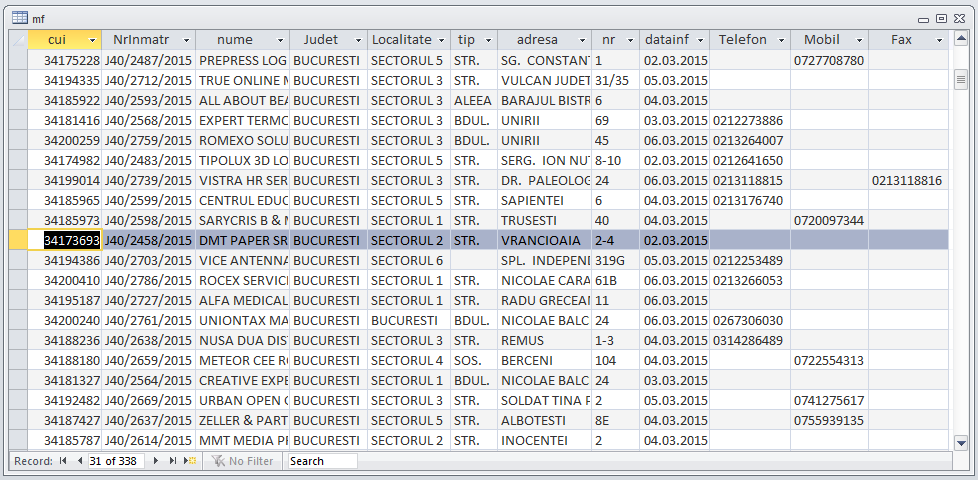
The New Companies service provides information about newly established companies, such as company name, registration number, tax ID, partial address, phone number where available, CAEN activity and business activity description, delivered by download or API, with filtering options by county or nationwide.
In practice, such a service is the real expression of a business need that is becoming increasingly clear: fast access to operational information while it can still generate commercial advantage.