
The balance sheet of companies in a way that everyone can understand
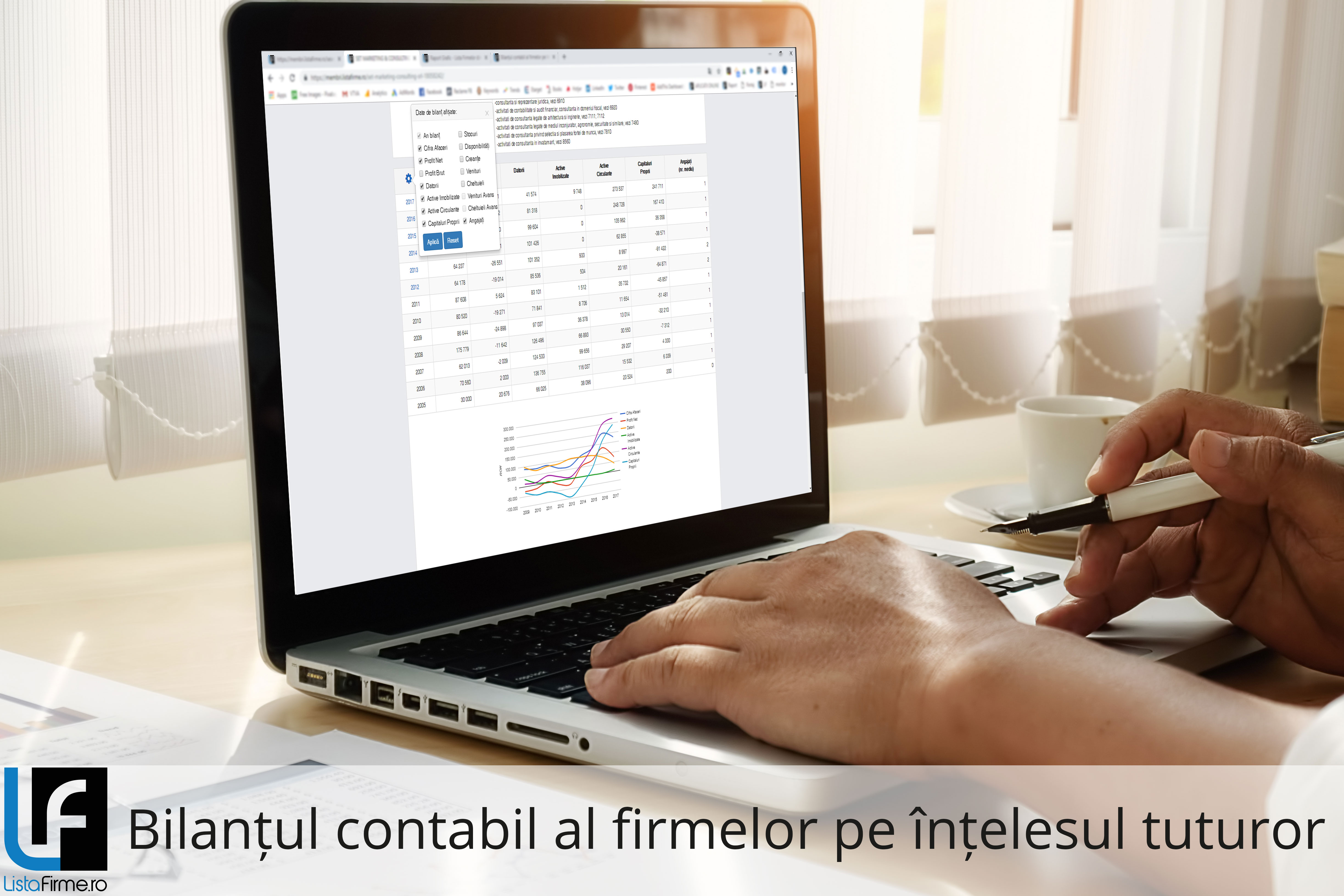
In economic activity, the balance sheet is the main tool for monitoring and evaluating the activity and financial health of a company. In other words, the balance sheet is a numerical summary of the activity undertaken by a company, represented by a table with two columns indicating on the one hand the economic goods (assets) and on the other hand the sources of financing (liabilities).
The preparation of the balance sheet emerged as a necessity for legally established economic entities to express and quantify their activity in figures, to have an evolutionary representation and to be able to plan subsequent activities. At the same time, the balance sheet is a tool for monitoring and controlling the activity by the authorized tax authorities (ANAF).
What is the balance sheet?
The balance sheet is the basic, summary financial document that expresses the financial situation of a company at a given point in time. The balance sheet is prepared periodically and captures, in amounts and figures, the summary of the company's activity at that point in its economic life.
Information about the company's activity is represented in a balanced manner, in two columns, assets and liabilities. The assets column (left) expresses the amounts generated/collected from its own activities, and on the right, in the liabilities column, debts and equity are recorded.
The usefulness of the balance sheet
Although many entrepreneurs see the balance sheet as just a tax obligation, it can also be a tool for analyzing, planning, and developing their business. The balance sheet helps to:
- evaluate the economic activity of the company;
- plan development and loss reduction;
- develop budget projects for further activities.
Who prepares the balance sheet?
Preparing the balance sheet is a legal obligation that applies to all economic agents (SRL, PFA, FI, etc.) and NGOs (foundations, associations, employers' associations, etc.).
The difference between the two types of economic activities is represented by the way the activities are recorded, as associations and foundations are not meant to record profit, unlike commercial companies whose primary purpose is profit.
According to the legislation in force, the financial accounting statement is prepared by the persons in charge of accounting management. It can be prepared internally by employed accountants or outsourced to specialized firms (outsourcing).
When are the financial statements prepared?
The balance sheet is prepared twice a year (biannually), respectively at the end of the year (december 31) and mid-year (june 30).
Once the financial statements are prepared, they must be submitted to the territorial National Fiscal Administration Agency.
Who must submit the balance sheet?
The balance sheet must be filed by all private or state legal entities that undertake economic activities.
Examples of entities filing financial statements:
- private commercial companies (SRL, SA, PFA, etc.);
- state-owned companies;
- autonomous kings;
- research and development institutions;
- NGOs (associations, foundations, employers' associations, unions, etc.).
Deadline for submitting the balance sheet
All entities that prepare the balance sheet are required to submit it within the legally established deadline.
For commercial companies, national companies, autonomous regies, national and research institutes, the deadline is 150 days from the end of the financial year (usually may 30 of the following year).
For other entities (e.g. NGOs), the deadline is 120 days from the end of the financial year.
Penalties for failure to file the balance sheet or improper filing
Failure to comply with the deadline and the legally imposed manner will result in misdemeanor sanctions (fines).
Fines range from 300 to 4,500 RON, depending on the severity of the offense. For example, filing late by up to 15 business days can result in a fine of between 300 and 1,000 RON, and over 30 days can result in a fine of up to 3,000 RON.
Irregularities regarding the signing and preparation of the balance sheet can be sanctioned with fines of up to RON 3,000.
The structure of the balance sheet, in brief
The structure of the balance sheet is unitary: four groups of basic elements that correspond to each column, asset and liability.
The balance sheet is prepared depending on the size and activity of the company (small, SME or large), with different thresholds related to turnover and number of employees.
There are two types of reporting: simplified balance sheet (small and medium-sized enterprises) and basic balance sheet (large enterprises).
The submitted package contains the balance sheet, profit and loss account, annexes and the management report.
Balance sheet
The balance sheet itself comprises two balanced columns: balance sheet assets and balance sheet liabilities.
Active
Assets include: fixed assets (intangible, tangible and financial), current assets (inventories, receivables), accruals (prepaid expenses/asset conversion differences) and bond redemption premiums.
Passive
Included in liabilities are:
- equity (share/individual capital, reserves, funds);
- provisions for risks and expenses;
- debts (loans, suppliers, budget obligations, debts to third parties);
- passive settlement accounts (advance income, passive conversion differences).
Assets are classified into accounts, groups and chapters, based on liquidity and demandability criteria.
Profit and loss account
The profit and loss account records income and expenses during the financial year and has a major economic role.
It is structured on principles of balance: income versus expenses (operating, financial, exceptional). The result of the exercise is the difference between income and expenses.
Annex to the balance sheet
Explanatory document detailing the patrimonial and financial situation, including supporting notes regarding profit distribution, inventories, receivables, outstanding payments, taxes and obligations due.
Balance sheet data on ListaFirme
On ListaFirme, along with other information, the main balance sheet indicators for recent years are presented in tables and graphs in each company's profile. company information.